
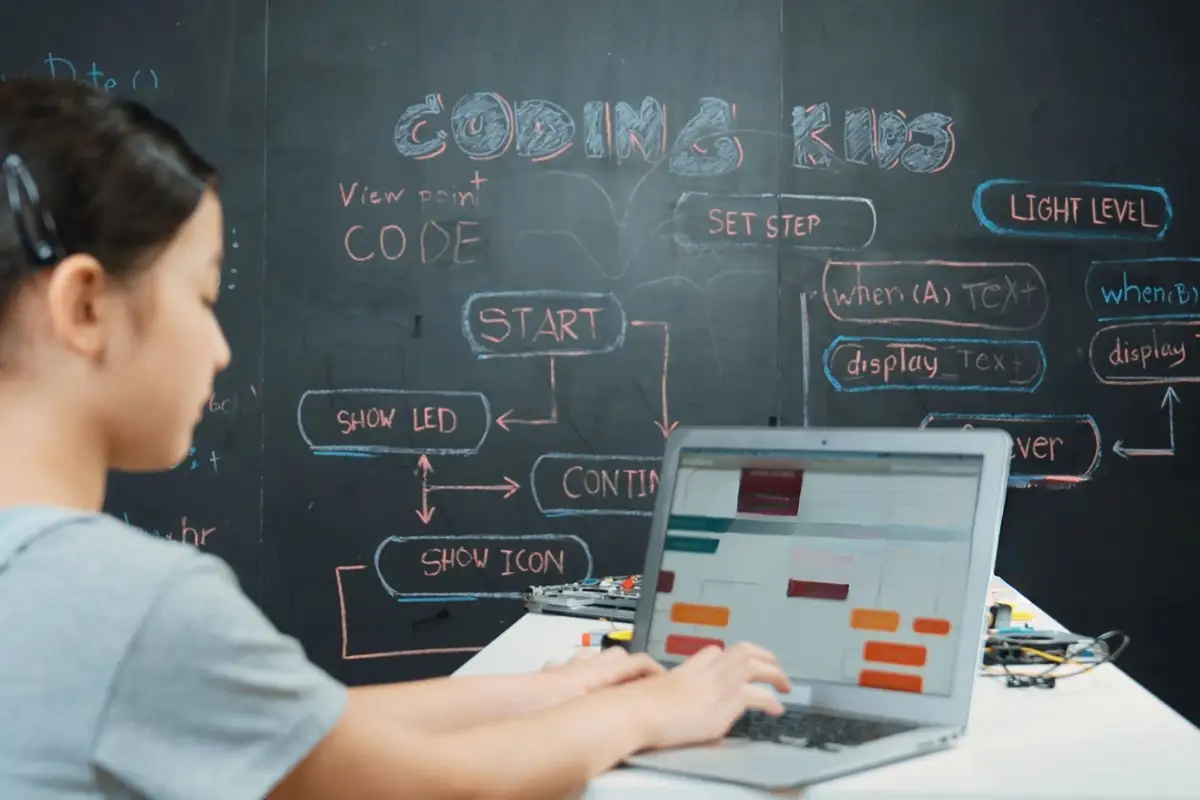
Coding Classes Grades 6-8 for Kids Ready to Go Beyond Playing With Code
Middle school consistently comes up when you ask most coding instructors where they see the biggest improvement in a student’s ability. Not because younger children aren’t capable; they certainly are, but rather because children in grades 6 through 8 usually have the reading stamina, abstract reasoning, and independent focus to work on a project over several sessions rather than completing it all at once.
For this reason, coding classes for kids look very different from what a child encounters earlier in their coding journey. This is the stage where students stop assembling pre-made components and start designing how a program should operate from the ground up. It’s not a slightly more difficult version of elementary coding.
What Changes Cognitively Around This Age?
There are a few things that happen developmentally from 11 to 14 years that make this period ideal for doing more advanced programming:
- Planning comes into play: A student can have the whole architecture of a program in mind before even touching the keyboard, rather than developing it piece by piece.
- Abstract thinking: It develops enough for such concepts as functions, arguments, and code reusability to be comprehensible, not just memorized
- Patience grows: A middle-schooler is ready to work through several setup sessions without seeing results until the end, unlike a younger kid who won’t get there.
- Self-debugging skills: This skillset develops that helps catch mistakes without constant assistance from the teacher and is found by analyzing the logic of what was done.
This development is the basis that allows coding courses in grades 6-8 to stop using graphical interfaces as the main way of teaching programming and switch to typing code directly.
What Middle Schoolers are Actually Building
Projects at this stage become significantly more sophisticated than earlier work, as they should, because students can handle them now. Some examples of the projects for this age band:
- Multi-file scripts: Using multiple scripts where some parts are placed in different files, making it look more like real-life software engineering
- Data analysis: Using a dataset (such as scores, climate data, or survey answers) to sort/filter and visualize it, bringing some aspects of data science together with programming
- Small full-scale application: To-do-list program, trivia game with scores, or any other simple program or website with interaction
- Programs using API: Connecting to external data sources such as weather data or trivia questions to bring some actual data inside of a project
If none of those projects work, it is time to start doing dry engineering without creativity. By contrast, students at this level usually come up with more interesting projects because they can finally implement their ideas fully and no longer need to simplify them (it could be a hobby tracker or even a game based on a student’s interests).
Why This Stage Cannot Be Skipped?
Middle school coding serves a specific structural purpose: it builds foundational habits. You learn to write readable code, test before assuming something works, and break a large problem into smaller, manageable pieces, skills a student who completes this stage carries into every subsequent project.
Coding usually begins much earlier. Computer coding for 5-year-olds is primarily about fostering comfort and curiosity through brief exercises, instant visual feedback, and no pressure to use “correct” syntax. While coding for 4th graders, the emphasis shifts to basic logical structures and completing small, independent projects. In middle school, a student either graduates into confident, independent programming or loses momentum because they’re pushed too quickly or held back too long. This is the first time those earlier habits are tested against real complexity.
What Should Parents Look For At This Stage?
Not all courses touting themselves as such will have what middle schoolers really need. Several things to look for include:
- Typed programming languages: Not a block language that extends some functionality, but proper Python, JavaScript, or any similar languages that will make up the core of the course, not just supplementary material
- Cumulative projects: A good curriculum will have projects where each lesson expands the capabilities learned in the previous one, not just a sequence of isolated single-lesson projects
- Opportunity for personalization: Middle schoolers learn much better when a project is something they are interested in, not just a generic project that is the same for everyone
- Learning how to debug: A good class should allow errors to happen occasionally and guide students to fix them, rather than showing only working programs.
Grades 6–8 coding classes are more than just “coding, but harder.” Getting this window right is one of the most important choices in a young coder’s entire learning path because it’s the point at which a child’s prior coding exposure either becomes a true, long-lasting skill or quietly stalls out. This is precisely the stage that the American Young Coder Academy middle school curriculum is built around: authentic projects, real languages, and teachers who know how to challenge students between the ages of 11 and 14 without going overboard. If your child is in this stage, contact them to schedule a trial class and see where they stand.